Why an Orthopedic Dog Bed Matters: Le Noof on Support and Smart Design
 by Christy Caplan
|
May 28, 2026
by Christy Caplan
|
May 28, 2026 Choosing a dog bed can seem simple—until your dog starts slowing down, struggling to get comfortable, or showing signs of stiffness after sleep. For dogs with joint pain, arthritis, or mobility issues, the right bed is more than a cozy place to nap. It can be an important part of daily comfort.
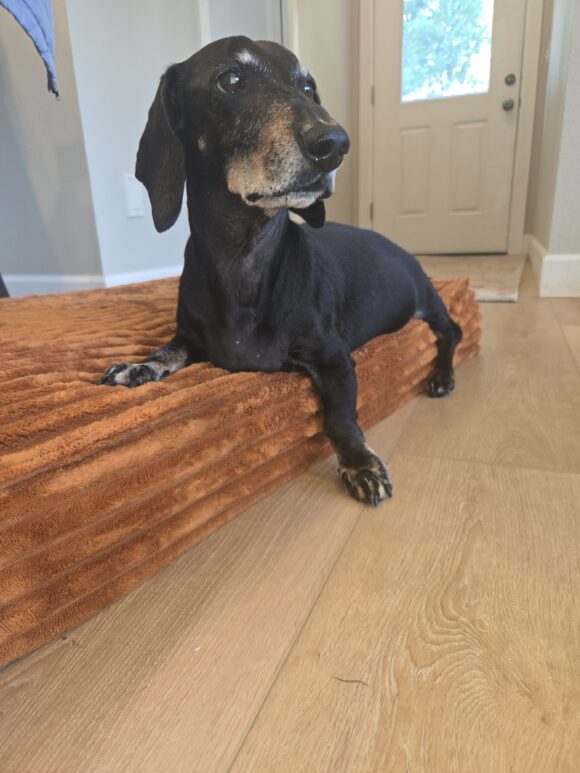
Le Noof, maker of the Tan Brown Flannel Orthopedic Dog Bed, says good support starts with what’s happening underneath the surface.
We asked Liva Mikelsone-Cudova, co-founder of Le Noof, about why this product was important to her: “French Bulldogs are prone to spinal and joint problems, so when we were designing the bed collection, proper orthopedic support wasn’t optional for us – it was personal. We just made sure it could belong in a living room, not just a vet’s office.”
What does Wally think?
As you can see from these photos, Wally loves the bed for his old bones. He’s 14 now and it’s obvious even with monthly acupuncture appointments that he needs more support when he’s getting up and down from a lying-down position. We move this bed from room to room and if it’s sunny and dry the bed ends up on the porch or in the backyard.
Real support starts with pressure relief
According to Le Noof, orthopedic support is about much more than softness.
“The foam is designed to distribute your dog’s weight evenly and cushion the pressure points where pain tends to show up first – hips, elbows, and shoulders,” says Mikelsone-Cudova.
That matters because older dogs and dogs with joint issues often feel discomfort where body weight presses hardest into the bed.
“When a dog lies on a thin bed that’s flattened over time, weight pushes down unevenly and creates pressure hotspots on already-sore joints. The orthopedic foam spreads that load across the whole surface so no single joint takes the full weight.” Thickness also plays a major role in whether a bed actually works.
“The medium and large sizes come in at 6 inches thick, which is important – it prevents dogs from sinking all the way through to the floor, which is what happens with cheaper beds and defeats the purpose entirely.”
Mikelsone-Cudova notes that while a supportive bed is not a replacement for veterinary care, it can still play a meaningful role in a dog’s quality of life.
“For dogs with diagnosed arthritis, a supportive bed won’t replace veterinary care – but vets consistently recommend it as a non-invasive way to reduce daily discomfort during the 12 to 16 hours most dogs spend at rest.”
Durability matters just as much as comfort
A supportive bed only helps if it keeps doing its job over time. That’s where the internal construction becomes especially important.
“The foam is CertiPUR-US certified, independently tested for content, emissions, and durability, so it holds its shape over time,” says Mikelsone-Cudova.
Waterproof protection that helps the bed last
Many pet parents know the challenge: even a great bed can be ruined by accidents, spills, or repeated washing. Le Noof says the waterproof lining is designed to protect the foam itself, not just the outer fabric.
The waterproof lining sits between the foam and the outer cover, so the foam itself stays dry even if there’s a spill or an accident.
That detail helps preserve the core support structure, which is often the first thing to fail in lower-quality beds. Other great benefits:
- Le Noof says both the flannel cover and liner are washable:
- Both the flannel cover and the liner are machine washable – cold water, gentle cycle, mild detergent.
- For long-term care, drying method matters.
“For the lining to last as long as possible, we recommend air drying flat, but tumble dry on low is fine when needed. Avoid high heat as it wears down the waterproofing over time,” adds Mikelsone-Cudova. Even the zipper was chosen with repeat washing in mind.
Choosing the right size is about more than breed
One of the most common mistakes dog owners make is choosing bed size based only on breed. Sleep style deserves equal attention.
“Breed is a starting point, but sleeping style matters just as much.”
They recommend watching how your dog naturally rests.
“Watch how your dog actually sleeps – do they curl up tight, or sprawl out with legs extended? Curlers generally fit their nose-to-tail measurement. Stretchers usually need to size up.”
Their best recommendation is refreshingly practical:
“The most reliable method is to measure your dog while they’re sleeping and compare directly to the size guide.”
And if your dog is between sizes, bigger is better.
“If your dog is between sizes, always size up – a bed that’s too small means legs hang off the edge, which defeats the joint support entirely.”
Le Noof’s sizing guidance is:
- Small (32″ x 24″): dogs up to 24″ nose to tail
- Medium (39″ x 28″): dogs up to 31″ nose to tail
- Large (47″ x 32″): dogs up to 39″ nose to tail
Safety claims mean more when they’re verified
Pet parents are seeing more product claims around “safe” and “non-toxic,” but third-party certifications help separate marketing from meaningful standards.
Le Noof says its two main certifications serve different purposes.
For the outer materials:
“OEKO-TEX Standard 100 applies to the fabrics – every component of the flannel cover is tested for harmful substances including pesticide residues, heavy metals, and formaldehyde.”
That may be more important than many pet parents realize. “Dogs spend far more time in contact with their bed than we do with furniture, so this matters more than most people realize.”
For the internal foam:
“CertiPUR-US applies to the foam – it certifies the bed was made without heavy metals, formaldehyde, restricted flame retardants, and phthalates, and sets limits on VOC emissions that affect indoor air quality for both dogs and their owners.”
Taken together, Le Noof says the certifications offer reassurance across the full bed, not just one component.
“Together, they mean every layer of the bed has been independently verified as safe – not just claimed to be.”
Designed by people who wanted something better in their own homes
For Le Noof, the design story began with a personal frustration. The company says it was founded by Liva and Janis, the designers behind Livette’s Wallpaper, after they adopted their two French Bulldogs, Alfy and Birky.
“They went looking for dog accessories that were high quality, easy to maintain, and wouldn’t look out of place in a well-designed home – and couldn’t find them. So they built the brand themselves.”
That origin helps explain why aesthetics and function appear to have been considered together from the start.
“The practical features weren’t add-ons. Washability, non-slip grip, removable cushions, YKK zippers – these were requirements from day one, because a beautiful bed that’s hard to clean isn’t actually a good bed.”
The bottom line
An orthopedic dog bed should do more than look attractive in your living room. It should support the body properly, hold up over time, protect against messes, and be made with materials you can trust. Based on Le Noof’s answers, their approach is built around all four.
For pet parents shopping for a dog with aging joints, stiffness, or mobility concerns, that combination of support, washability, sizing guidance, and verified materials may be what makes the difference between just another pet bed—and one your dog truly benefits from.
*Le Noof sent us this bed to test and review, all opinions are honest and transparent and our own.