A New Guide: “Old Dog, New Dog…” Just Released
 by Christy Caplan
|
June 26, 2025
by Christy Caplan
|
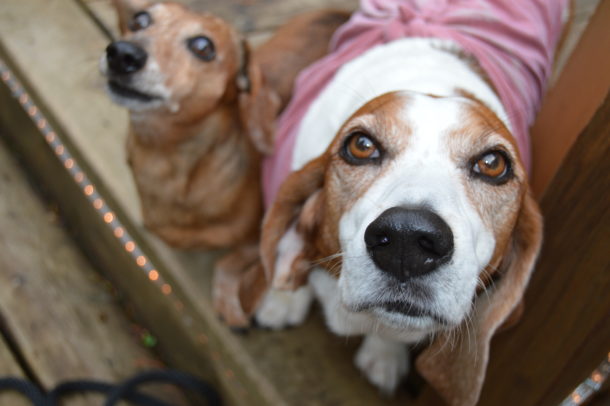
June 26, 2025 Kathy Callahan and Helen St. Pierre just launched a book we can all relate to, and I devoured it after my experience with Herschel and Walter these past three years. How do you introduce your new puppy to your senior dog? This is difficult! This guide provides tips and tricks.
I chose to do a Q&A with the authors, and I hope you enjoy what they have to say!
Q. What are the key factors dog owners should evaluate when deciding if it’s the right time to introduce a puppy into a household with a senior dog?
While there are many topics to cover in the should-we-or-shouldn’t-we puppy conversation, the key factor may sound surprising, because it’s not about the dogs. Here it is:
What’s the bandwidth of the humans in your household these days?
The truth is that we can’t predict with certainty exactly how the addition of a puppy will go in each unique home, because there are simply too many factors at play. That’s why the most important one is the humans’ ability to roll with the experience as it plays out. When you hit a bump in the process — say, the older dog’s health takes an unexpected dive — the answer will be humans pitching in to make adjustments.
If, as you ponder getting a puppy, you’re thinking you can squeeze in just enough time and energy for the dream scenario (where the dogs adore each other, play beautifully, and nobody needs “extra”) . . . then this is not the right time to add a puppy. Picture the tough time instead. Can you still do it?
Q. How can owners manage the unique challenges of balancing the physical and emotional needs of an aging dog alongside the energetic demands of a new puppy?
Anticipation is the unsung hero of life with a puppy and a senior! It pays to think the day through.
What often makes puppyhood so difficult is that it seems every time you turn around there’s a new disaster: pee on the floor, the toddler knocked to the ground, the remote control chewed, etc. Add to that scenario a senior dog who’s suddenly unable to use stairs, or unexpectedly snapping at visitors, and you have a perfect storm.
But it doesn’t have to be that way.
Anticipate: What does each dog need? What’s going to be challenging? How can you get ahead of the tough times of day by scheduling in the use of gates, sniffari’s, Toppls, puppy playdates, snuggle time on the couch, fun training sessions, and crates? Play ways to divide and conquer, by getting more hands on deck so that a senior gets porch time with his person in the sun, while a puppy gets a playdate with an energetic friend.
Working out a routine where each dogs’ needs can be met daily is the secret to getting to relish this very full moment.
Q. What strategies can help ensure a smooth and respectful introduction between a senior dog and a new puppy to foster a harmonious relationship?
The day before the puppy comes home, create a clear plan for the introduction. Don’t wing it! Here’s the guiding principle to follow:
AGENCY: Both dogs need to feel that they can have the distance and time they need to assess the situation.
When you’re holding a puppy tight in your arms, or restraining your adult with a leash, it interferes with their sense of agency. That’s why the best introductions often happen through a see-through barrier (pen, fence, gate) when both dogs have four paws on the floor. That way they each have the option of moving closer to sniff, or farther away to observe.
The other key to success: Be patient. If there’s good body language on both sides — obvious interest, no retreats, loose bodies, play bows — fantastic! Now . . . continue to wait! Sometimes, to go fast you have to go slow. The more time you give these two to get to feel comfortable with each other while that barrier is still up, the faster you’ll get to the time when it’s safe to remove that barrier.
Keep in mind that management is absolutely essential long after this initial meeting! Almost every puppy will want to be all over the senior dog 24/7. At the same time, almost every senior will be seeking an escape from that constant babysitting job. The #1 predictive factor in happy senior/puppy homes is when the humans make sure the senior is never “stuck” with the puppy, and always gets to choose that interaction.
Q. How does “Old Dog, New Dog” guide readers in making compassionate decisions about end-of-life care for their senior dog while managing the joy and chaos of raising a puppy?
Unfortunately, our society tends to avoid any topics that surround death. As a result, we’re woefully unprepared when it comes to navigating the later stages of our dogs’ lives. All too often, people let themselves remain blissfully unaware of their dogs’ slow decline. That’s a shame, because there is actually a great deal we can do to make them much more comfortable as they age — turning that stage into a very enjoyable one with its own beautiful rewards.
But you can’t assist your aging dog if you refuse to see the situation, so the first thing we do in Old Dog, New Dog is help folks to truly observe their senior friends more closely. We teach people to evaluate their older dogs in three ways: function, purpose, and joy. To have a good quality of life they must have all three.
Then, in one of the most important chapters of the book, we guide people through the subject of euthanasia. We explain why we think it’s such a gift to be able to alleviate our dogs’ suffering, and we talk through how to know when “it’s time.” We demystify the actual process so that fear of the unknown isn’t a stumbling block.
Giving a beloved old dog a good “quality of death” can help enormously in processing grief. And of course, a happy, bouncy puppy can sometimes be just what the doctor ordered – a wonderful distraction, and a great place to put all of that love. Still, it’s normal to have conflicted feelings for a while as you continue to work through loss. (“Ugh, I don’t feel the same about this new dog.”) But what we see over and over is that at some point you begin to have the sense that your sweet old friend may be whispering in your new puppy’s ear: “Hey, she likes it when you put your head right in her lap, yeah, just like that.” Suddenly, the endings and beginnings feel woven together.
Thank you, Kathy and Helen!
Kathy Callahan and Helen St. Pierre are the authors of Old Dog, New Dog: A Guide to Supporting Your Aging Best Friend and Welcoming a New One.
Helen St. Pierre is the founder of the senior animal rescue and sanctuary Old Dogs Go To Helen and the owner of No Monkey Business Dog Training. She is certified as a professional dog trainer (CPDT-KSA), a dog behavior consultant (CDBC), and a family dog mediator (LFDM). Helen’s website is nomonkeybusinessdogtraining.com
Certified dog trainer (CPDT-KA) and family dog mediator (LFDM) Kathy Callahan specializes in puppies. The author of Welcoming Your Puppy from Planet Dog and 101 Rescue Puppies, she writes monthly on training and behavior for Whole Dog Journal. Her business, PupStart, focuses on helping clients through puppyhood. Her website is www.puppypicks.com.